James Hardie Siding in Denton, TX
Serving Denton County and North Texas
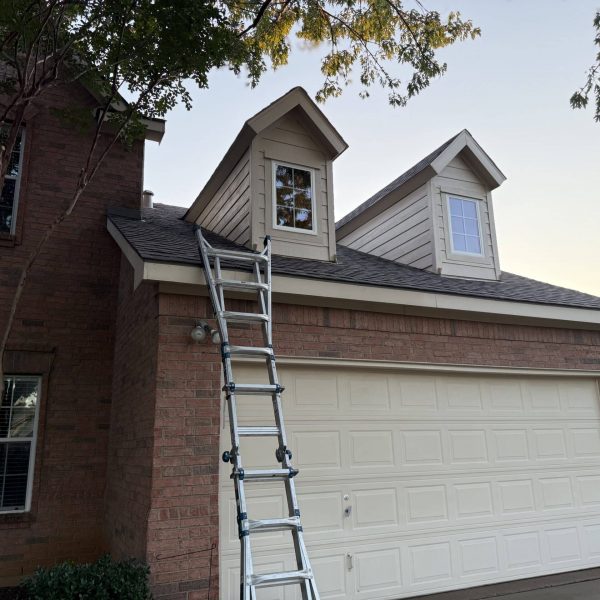
James Hardie fiber cement siding is the most durable cladding most Denton homeowners will seriously consider, and it is the material we install most often on homes across Denton County. It is noncombustible, it does not rot, termites have nothing to eat, and it holds paint far longer than wood.
Renewal Home Exteriors is a siding company in Denton, TX that installs James Hardie siding on homes in Denton, Corinth, Argyle, Flower Mound, and the surrounding communities. We give you a written estimate before anything gets torn off, and we tell you honestly when a siding repair makes more sense than a full siding replacement.
Why James Hardie Siding Holds Up in North Texas
North Texas is hard on siding for three specific reasons, and fiber cement answers all three better than vinyl or wood.
Hail. Denton County averages roughly seven days a year with reported severe hail, based on twenty years of National Weather Service storm data. The North Texas record hailstone, 5.9 inches across, fell in Sanger on June 15, 2023, about fifteen minutes north of our office. Vinyl siding cracks and punches through under that kind of impact. James Hardie boards resist it far better, though no siding on the market is hail-proof and anyone telling you otherwise is selling.
Heat. DFW averages 20 days a year at or above 100 degrees, with normal August highs near 96. Vinyl expands, contracts, warps, and eventually buckles under that cycle. Fiber cement barely moves. It also holds color instead of chalking out on the south and west walls, which is where every faded house in Denton fades first.
Freeze and thaw. DFW sees about 29 days a year that drop to freezing, and almost all of them thaw by afternoon. That repeated wet-freeze-dry cycle is what works moisture into wood siding and opens up joints. Hardie board does not absorb water the way wood does, so it does not swell and split from it.
There is a fourth factor worth understanding, and it is one most contractors will not bring up. The soil under Denton is expansive clay. The USDA’s Sanger soil series has its national type location eight miles south of Denton, and it runs 40 to 60 percent clay with cracks that open one to three inches wide in a dry summer. That ground moves. Siding does not stop foundation movement, and no siding warranty covers damage caused by it. What good siding does is stay intact and keep water out while the house does what North Texas houses do.
What Is HZ10, and Why Does It Matter in Denton?
James Hardie manufactures two product lines for two climate groups, and everything sold in Texas is HZ10.
Under the Hardie Zone System, HZ5 boards are engineered for northern climates with freezing temperatures, heavy snow, and ice. HZ10 boards are engineered for the opposite problem, what James Hardie describes as areas with hurricane-force winds, salty sea air, and the brutal, humid heat of the south. Every ZIP code in Texas falls in the HZ10 zone, including all of Denton’s, 76201 through 76210, along with Argyle, Aubrey, Justin, Krum, Lake Dallas, and Lewisville.
You can verify this yourself without taking our word for it. Walk into the Home Depot or Lowe’s in Denton and read the label on the siding stack. It says HZ10.
This matters because it is a real, checkable difference in the product, not a sales angle. If a contractor cannot tell you which zone board they are ordering for your house, that is worth noticing.
Which James Hardie Products Do We Install?
We install the full James Hardie exterior line, and which products go on your home depends on the architecture more than on preference.
• Hardie Plank Lap Siding. The horizontal lap board most people picture when they think of Hardie. Cedarmill texture reads like wood grain from the street. Smooth reads modern. This is the workhorse on most Denton homes.
• Hardie Panel Vertical Siding. Large-format vertical panels, usually paired with battens for board-and-batten. Common on newer builds and on gables.
• Hardie Shingle Siding. Shake and shingle appearance without the cedar maintenance. Usually used as an accent on gables, dormers, and entry sections rather than a whole elevation.
• Hardie Architectural Panel Siding. Textured panels in Fine Sand, Mounded Sand, and Sea Grass. Worth knowing before you fall in love with a color: this product ships primed only, so it gets painted on site.
• Hardie Trim Boards and Batten Boards. Corners, fascia, window and door trim, and the battens on board-and-batten walls.
• Hardie Soffit Panels. Vented and non-vented, for eaves and porch ceilings.
• Hardie Weather Barrier. The housewrap, flashing, and seam tape that go on behind the siding. This layer is invisible when the job is done, which is exactly why it is the layer that gets skipped.
On color. ColorPlus Technology is James Hardie’s factory-applied finish, baked on in a controlled shop rather than rolled on in a Texas driveway. It costs more up front and it holds up better. The alternative is primed board painted on site, which gives you unlimited color choice and a shorter repaint cycle. We will price both.
What Does James Hardie Siding Cost in Denton, TX?
Most James Hardie projects on a typical Denton home land somewhere between $15,000 and $30,000 installed, but that range is wide for real reasons and any number quoted before someone looks at your walls is a guess.
Published national data for 2026 puts fiber cement between $7 and $18 per square foot installed, with a Texas average around $13,900 for a full project, according to Angi’s fiber cement cost guide updated in August 2026. HomeGuide’s James Hardie specific guide runs higher, $16 to $40 per square foot when tear-off and prep are included. That gap is not disagreement about price. It is a difference in what each guide counts.
What actually moves your number:
• How much wall there is. Two-story homes cost more per square foot of floor area than single-story, because there is more siding and more staging.
• What comes off first. Removing and hauling old siding is real labor. Removing two layers is more.
• What is underneath. Rot in the sheathing or framing has to be repaired before new siding goes on. We do not know this until the old material is off, which is why our estimates say what happens if we find it.
• ColorPlus or primed and painted. Different material cost, different labor, different repaint schedule.
• Trim, soffit, and detail work. A house with a lot of windows, gables, and corners has a lot of trim.

James Hardie vs. Vinyl Siding in North Texas
Vinyl is cheaper up front. That is a real advantage and we install it. But on a Denton home
the comparison is not close on durability.
James Hardie fiber cement Vinyl
Hail impact
Heat movement
Fire
Termites and rot
Color life
Up-front cost
Board weight and install
Resists impact well; can still be damaged in a severestorm
Minimal expansion and contraction
Noncombustible, complieswith ASTM E136 as a noncombustible cladding
No food value, does not rot
ColorPlus finish carries a 15-year limited warranty
Higher
Heavy, requires trained crews and correct fastening
Cracks and punctures at lower impact, especiallywhen cold
Expands, contracts, and can warp or buckle
Melts and burns
Does not rot, but hides
moisture problems in the
wall behind it
Fades, most visibly on south
and west walls
Lower
Light, faster to install
A note on fire, because it gets overstated constantly. James Hardie’s own language is that its fiber cement products are noncombustible and comply with ASTM E136 as a noncombustible cladding, and that fiber cement fire resistance does not extend to applied paints or coatings, which may be damaged or char when exposed to flames. It is not fireproof. Nobody’s siding is.

How We Install James Hardie Siding
1. Inspection and written estimate. Someone comes out and looks at the actual condition of the walls, not a photo. You get a written estimate that says what we are doing, what it costs, and what happens if we find rot underneath.
2. Product and color selection. We bring samples. You see Hardie Plank next to Hardie Panel, Cedarmill next to Smooth, and ColorPlus next to primed, on your house in your light, before you commit.
3. Tear-off and inspection of the wall. Old siding comes off. We check sheathing and framing for rot and water damage and show you anything we find before we cover it back up.
4. Weather barrier and flashing. Hardie Weather Barrier housewrap, flashing at every penetration, and seam tape. This is the step that separates a siding job that lasts from one that looks fine for four years.
5. Installation to James Hardie specification. Correct fastening, correct clearances at grade and at the roofline, correct joint treatment. Fiber cement installed wrong fails whether or not it is the best board on the market.
6. Caulk, paint touch-up, and cleanup. Then a final walkthrough where we go over the workmanship warranty with you.
Signs Your Denton Home Needs New Siding
You probably do not need a full replacement for one cracked board. A targeted siding repair usually handles that. You likely need siding replacement if you are seeing several of these at once.
- Soft spots. Press on the siding near the bottom of a wall. If it gives, water has been getting in for a while.
- Peeling or bubbling paint that keeps coming back. Paint failing repeatedly in the same place is usually moisture behind the board, not bad paint.
- Warped, buckled, or wavy walls. Common on vinyl after enough Texas summers.
- Hail bruising or cracking. Especially on north and west elevations after a storm. Worth documenting for insurance.
- Gaps at joints, corners, and around windows. Every gap is a path for water.
- Rising energy bills with no other explanation. Failing siding and failing insulation often show up together.

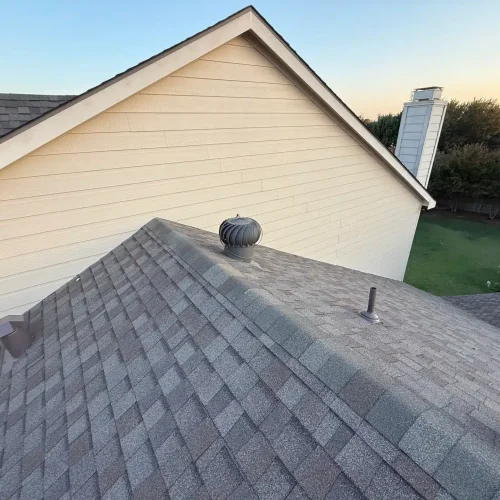
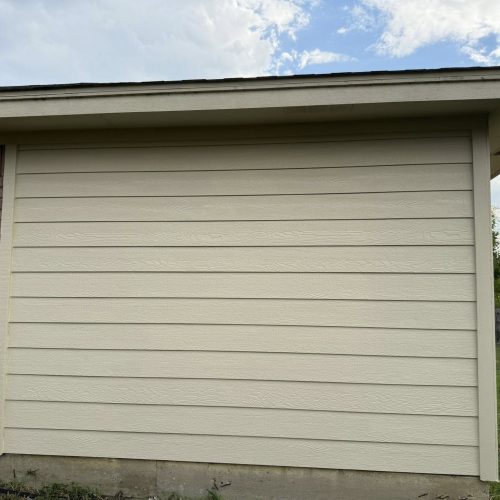
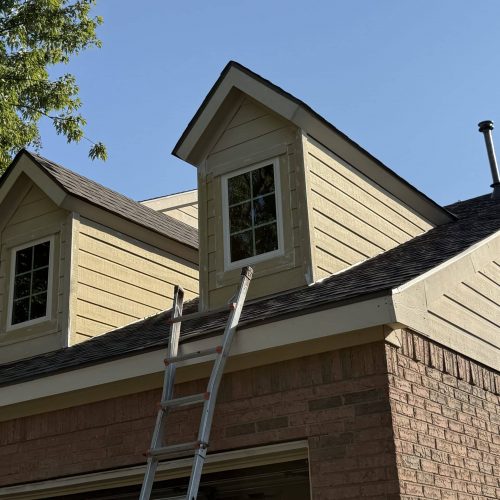
Recently Completed Projects




Areas We Serve
Renewal Home Exteriors installs James Hardie siding across Denton County and the surrounding North Texas communities, including Denton, Corinth, Argyle, Flower Mound, Highland Village, Lewisville, Lake Dallas, Hickory Creek, Sanger, Krum, Aubrey, Little Elm, Lantana, Trophy Club, Roanoke, and Justin.
Not sure whether your address falls inside our service area? Call (940) 631-1970 and we will tell you straight.
Get a Free James Hardie Siding Estimate in Denton
If your siding is failing, or you are planning ahead and want to know what James Hardie would cost on your house, we will come look at it and put a real number in writing.
No pressure, no same-day-only pricing, and an honest answer about whether you need a full replacement or a repair.
Frequently Asked Questions
What is the downside of James Hardie siding?
Three things. It costs more up front than vinyl. It is heavy, which means installation takes longer and requires a crew that knows how to fasten and cut it correctly. And it is not maintenance-free: caulk joints need attention over time, and primed board will need repainting on a normal exterior paint cycle. Installed correctly, it still outlasts vinyl by a
wide margin in North Texas conditions.
Do termites eat Hardie board?
No. James Hardie fiber cement is made of cement, sand, and cellulose fiber, and it offers
termites nothing to eat. That said, termites can still reach the wood framing and sheathing
behind any siding through the ground or through gaps, so fiber cement is not a substitute
for termite treatment
How long does James Hardie siding last?
James Hardie warrants the board itself for 30 years against manufacturing defects, and properly installed fiber cement commonly stays serviceable beyond that. The finish is the shorter-lived component. ColorPlus carries a 15-year limited finish warranty, and primed board painted on site will need repainting sooner than that.
Is James Hardie siding worth it in North Texas?
For most Denton homeowners planning to stay in the house, yes. The case is hail resistance,
heat stability, noncombustibility, and a finish that holds color through Texas summers. If
you are selling within a year or two, vinyl may make more financial sense, and we will tell
you that.
Do I need a permit to replace siding in Denton?
Requirements vary by city and by whether structural repair is involved. We handle
permitting where it applies and tell you up front if your project needs one.